
The 1980s AI photo trend is simple to describe and surprisingly easy to get wrong: you upload one photo of yourself, ask an image model to show what you would have looked like in 1985, and it hands you back a faded print from a family album.
When it works, people who know you say "wait, is that your mum?" When it doesn't, you get something that is unmistakably retro but unmistakably not 1985 — most often, it lands somewhere in the mid-90s. This post is about the difference.
Each decade in one line
Before any prompt vocabulary, this is the mental model. If you can hold these five lines in your head, you can look at any AI retro photo and name the decade it actually landed in:
- 60s — composed, clean, like a magazine portrait.
- 70s — warm, loose, slightly psychedelic or slightly rural.
- 80s — big, bright, trying hard. The most dressed-up photo in the family album.
- 90s — casual, direct flash, like a friend took it without asking.
- 00s / Y2K — bright, plasticky, that early digital camera smell.
The one that carries the most weight is the third one. The 80s look is an effort level, not a filter. Everything below is downstream of that.
Why your 80s photo comes out looking like 1995
Here are two outputs from the same generator, same kind of input photo, both asking for a retro portrait. One is 1985, one is 1995.
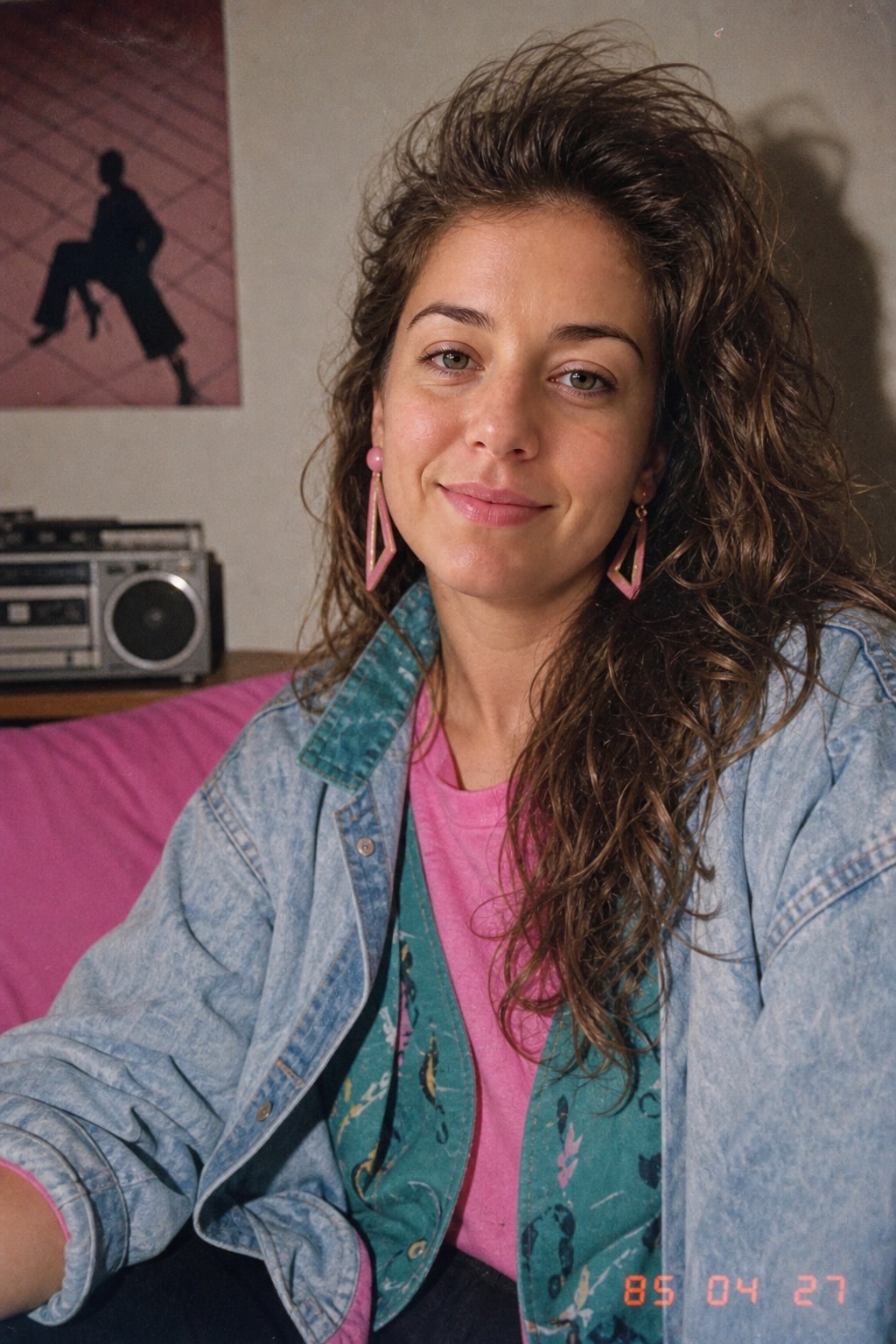
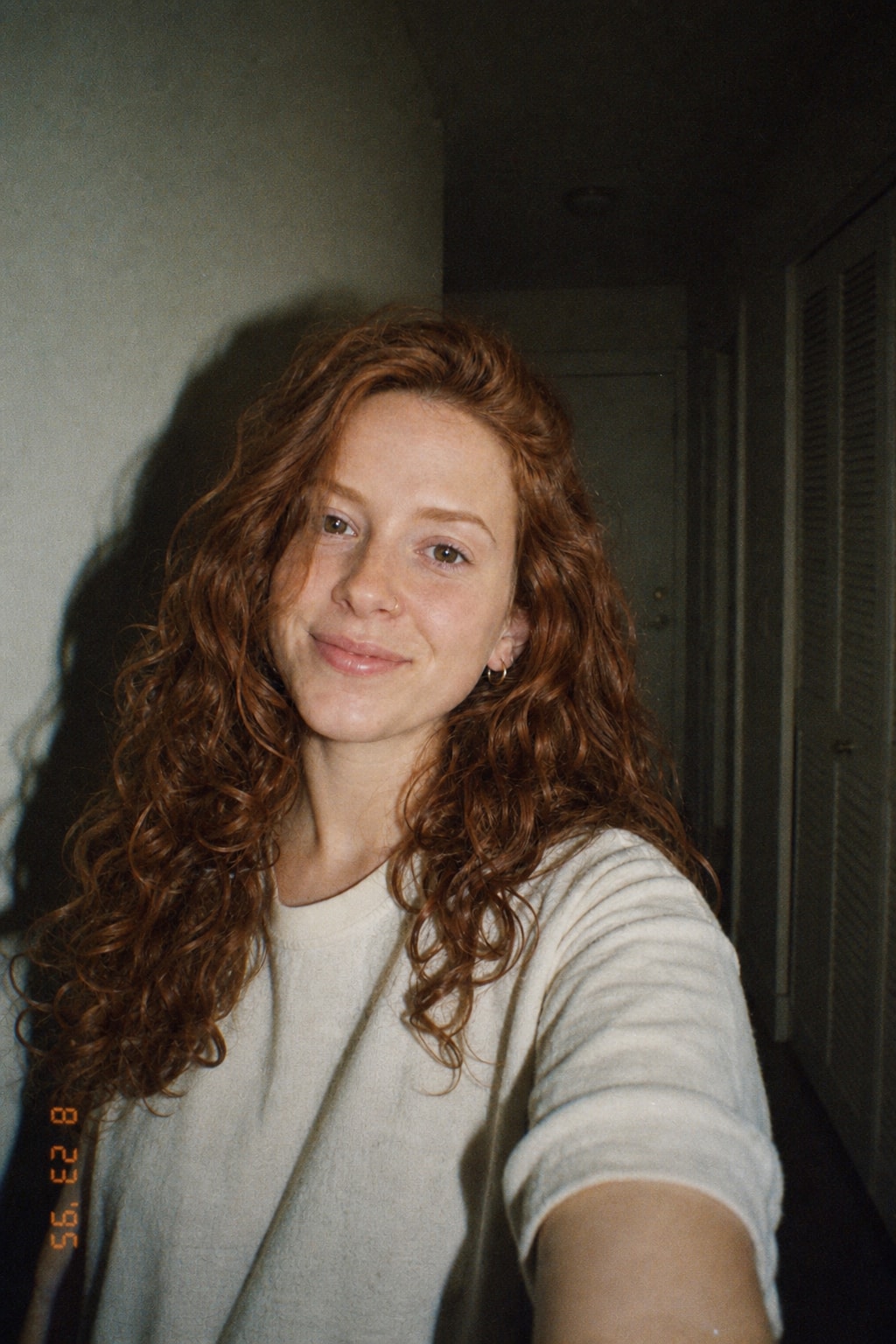
Count what is happening in each frame.
The 1985 one carries, simultaneously: hair with deliberate volume, a colour collision (hot pink against teal), acid-wash denim, statement earrings, a patterned scarf, a poster on the wall, a boombox on the sideboard. Seven decisions, all of them loud, all of them pointing at the same year.
The 1995 one carries: a plain tee, untouched hair, a hallway. Three decisions, all of them quiet.
That is the whole difference. 80s is high-information. 90s is low-information. When a prompt says "80s style" and the model gives you one vintage jacket in a beige room, it hasn't failed at rendering — it has failed at density. You will read that image as 90s, because sparseness itself reads as 90s.
The signal everyone trusts that proves nothing
Look at the bottom corner of both images. The 1985 print has an orange date stamp. The 1995 print also has an orange date stamp.
Date stamps are in nearly every "80s prompt" circulating right now, usually as the clincher. They are not a decade signal. Consumer cameras stamped dates from the early 80s straight through the late 90s, and models have learned them as a generic "old photo" cue, not an 80s one. Keep the date stamp — it does add authenticity — but if it is the main thing carrying your 80s claim, the photo is not going to read as 80s.
The five signals that actually say 1985
In rough order of how much work they do:
- Volume. Hair with height and width, shoulders with structure. The 80s silhouette occupies more space than the person inside it. This single element does more than the other four combined.
- Colour collision. Not "warm tones" — clashing saturated tones. Hot pink and teal. Yellow and purple. The decade did not do tasteful adjacent palettes.
- Direct flash on saturated film. Hard specular highlights, flat frontal light, shadow thrown sharply onto the wall behind. Warm, dense colour that has faded rather than greyed.
- Props that date themselves. Boombox, CRT TV, wood panelling, painted studio backdrop, rotary phone, VHS tape. One per frame is enough; the model will build the room around it.
- The date stamp. Real, and worth including — just demoted, for the reason above.
Anything you drop from this list, you should replace with something else loud. The failure mode is never "too much 80s."
Decade by decade: what actually changes
| Decade | Clothing | Hair & makeup | How the photo was taken | Colour & texture | Typical setting |
|---|---|---|---|---|---|
| 60s | Sharp, fitted, modest | Neat volume or tidy short hair, restrained makeup | Studio, medium format, soft light | Warm, gently soft-focus | Studio, living room, formal portrait |
| 70s | Loose, earth tones, hippie or disco | Centre-part long hair, big curls, natural or heavy makeup | Film, warm light, slightly soft | Brown, amber, heavier grain | Street, living room, party, park |
| 80s | Exaggerated shoulders, bright colour, layered | Big hair volume, statement jewellery | Studio strobe or on-camera flash | Warm, saturated, hard highlights | Living room, portrait studio, club, family group |
| 90s | Denim, flannel, basics, casual | Looser, more careless; lighter makeup or smudged | Point-and-shoot, disposable camera, direct flash | Faded, grainy, slightly cool or yellowed | Mall, campus, bedroom, street |
| 00s / Y2K | Low-rise, shiny fabrics, metallic, fitted tops | Chunky highlights, straight hair or flipped fringe, glossy lips | Early compact digital camera, overexposed flash | Cyan cast, digital noise, sharp but unclean | Party, bedroom, mall, night shots |
Three rows in that table are live styles on this site — the 1980s photo prompt, the 90s photo trend prompt and the Y2K style portrait prompt — so you can put your own face against all three and see the gap on one person rather than three strangers.
The transitions matter more than the decades
Most misreads happen at boundaries, not centres:
- 70s → 80s. Both are warm. The 70s is warm and muddy (amber, brown, soft); the 80s is warm and saturated (pink, cyan, hard-edged). If your 80s attempt looks nostalgic but murky, you've drifted into 1977.
- 80s → 90s. Both use flash. The 80s uses it on a dressed-up subject in a decorated room; the 90s uses it on whoever is standing there. Effort, not equipment.
- 90s → Y2K. Both are noisy. But 90s noise is film grain — organic, evenly spread. Y2K noise is digital — blotchy in shadows, with a cyan cast and a strange over-sharpened edge. Asking for "grain" in a Y2K prompt gets you 1996.
Prompt vocabulary, per decade
Terms that reliably pull the right era. Use three or four, not all of them:
- 1960s —
studio portrait,modest silhouette,soft focus,elegant 1960s styling - 1970s —
warm amber tones,heavy grain,candid 1970s film photo,golden hour,wide collar - 1980s —
mid-1980s styling,direct flash,analog grain,teased hair,shoulder pads,red-orange date stamp - 1990s —
disposable camera,point-and-shoot flash,faded consumer film,candid snapshot,oversized flannel - 2000s / Y2K —
early compact digital camera,harsh flash,low-res noise,Y2K fashion,butterfly clips
The 90s splits further, and the sub-genres are far apart: school/mall studio (blue-purple laser backdrop, sweater, seated smile), grunge (flannel, low saturation, dim), club (direct flash, magenta-and-cyan cast, leather or a slip top), and family album (living room, fluorescent ceiling light, completely ordinary clothes — this last one is the most convincing and the least attempted).
Copy-paste prompts, one per decade
Each of these is the same skeleton — identity clause, styling, camera, light, colour, exclusions — with the decade block swapped. Change the year and the setting freely; keep the first two lines and the last line exactly as they are, because those are what protect your face.
1964
Using my uploaded photo, show me what I would have looked like in 1964.
Preserve my identity, facial features, skin tone, age, and recognizable appearance.
Restyle my hair, clothing and surroundings as early-1960s: sharp fitted tailoring, modest silhouette, neatly set hair, restrained makeup.
Render it as a genuine medium-format studio portrait: soft frontal light, gentle shadows, warm tones, fine grain, slight soft focus.
No modern phones, no LED ring lights, no current logos, no beauty retouching.
1975
Using my uploaded photo, show me what I would have looked like in 1975.
Preserve my identity, facial features, skin tone, age, and recognizable appearance.
Restyle my hair, clothing and surroundings as mid-1970s: flared trousers, earth tones, wide collars, corduroy or floral print, centre-part long hair.
Render it as a genuine 35mm consumer film photo: golden-hour or tungsten light, amber and brown cast, heavy grain, slightly hazy.
No modern phones, no LED ring lights, no current logos, no beauty retouching.
1985
Using my uploaded photo, show me what I would have looked like in 1985.
Preserve my identity, facial features, skin tone, age, and recognizable appearance.
Restyle my hair, clothing and surroundings as mid-1980s: shoulder pads, teased high-volume hair, clashing saturated colours, statement jewellery, acid-wash denim, a boombox or CRT TV in the room.
Render it as a genuine direct-flash photo on consumer film: hard frontal flash, a sharp shadow on the wall behind me, warm saturated colour, faded print, a small red-orange date stamp in the corner.
No modern phones, no LED ring lights, no current logos, no beauty retouching.
1995
Using my uploaded photo, show me what I would have looked like in 1995.
Preserve my identity, facial features, skin tone, age, and recognizable appearance.
Restyle my hair, clothing and surroundings as mid-1990s: plain denim, flannel or a white tee, untouched hair, minimal makeup, an ordinary room.
Render it as a genuine disposable-camera snapshot: direct flash, my face slightly overexposed, the background falling away to dark, coarse grain, faded slightly cool colour, slightly crooked framing.
No modern phones, no LED ring lights, no current logos, no beauty retouching.
2003 — or skip the copying: the Y2K style portrait prompt has this and six more early-2000s setups ready to run on your photo.
Using my uploaded photo, show me what I would have looked like in 2003.
Preserve my identity, facial features, skin tone, age, and recognizable appearance.
Restyle my hair, clothing and surroundings as early-2000s Y2K: low-rise denim or velour, a fitted baby tee, glossy lips, chunky highlights or butterfly clips, silver jewellery, a flip phone.
Render it as a genuine early compact digital camera photo: harsh on-camera flash, blown-out highlights, cool washed colour with a cyan cast, visible digital noise rather than film grain, slightly soft.
No modern phones, no LED ring lights, no current logos, no beauty retouching.
The two lines that matter most are the same in all five. Line 2 is the identity clause — without it you get a period-accurate stranger. The last line is the exclusion list, and it is doing more work than it looks: one modern object in frame and the viewer stops believing the photo.
Three mistakes that flatten the decade
Asking for soft studio light. Almost every era on this list used direct flash for everyday photos. Soft, wrapped, flattering light reads as now, and it silently cancels the rest of your prompt. Say direct flash explicitly.
Leaving the year open. "80s style" gives you a decade-shaped average. 1985 or mid-1980s gives you a year. Specific years pull specific silhouettes; the average pulls whatever was most photographed, which is rarely what you wanted.
Letting modern objects into frame. One current smartphone, one ring light, one modern car in a window and the illusion collapses — the viewer doesn't consciously notice the object, they just stop believing the photo. Name them as exclusions.
The hard part isn't the decade — it's the face
Everything above is solvable with vocabulary. This part isn't.
The common failure of the 1980s AI photo trend is that you get an 80s person, not 80s you. The hair is right, the jacket is right, the flash is right, and the face belongs to a stranger. It happens because a text-only prompt has no obligation to your features — it renders a plausible human wearing your decade.
Two things fix it:
- Work from your photo, not from a description. Image-to-image starts from your actual face instead of reconstructing one.
- Write the identity clause explicitly.
Preserve my identity, facial features, skin tone, age, and recognizable appearance.Without that sentence the model treats your face as another thing it is free to restyle. It is the single highest-value line in any decade prompt.
Both are already wired into the 1980s photo prompt style here — upload once, and the identity clause and the period vocabulary are applied together, with the prompt visible and editable if you want to push the year or the setting.
If you're going the other direction — you have a real photo from 1985 and want it repaired rather than recreated — that's a different job, covered in restoring old photos.
FAQ
Why does my 80s photo look like the 90s? Almost always information density. The 80s dressed up and decorated the room; the 90s didn't. If your frame contains one retro item and a plain background, it reads 90s no matter which year you named. Add volume, a colour clash and one period prop.
Is the orange date stamp an 80s thing? It's an old photo thing. Consumer cameras stamped dates from the early 80s through the late 90s. Include it for authenticity, but don't rely on it to carry the decade.
What's the difference between 90s grain and Y2K noise? 90s grain is film: organic, evenly distributed, warm. Y2K noise is digital: blotchy in the shadows, cyan-tinted, with over-sharpened edges. They are opposite textures, and asking for the wrong one drops you into the wrong decade.
Which decade is easiest to get right? The 80s, because its signals are the loudest and models have seen enormous numbers of scanned 80s prints. The hardest is the 90s family-album look — ordinary clothes, ordinary room — because there's almost nothing for the model to hold onto.
Can I do this for a whole family photo? Yes, and group shots are often the most convincing, because period clothing on several people reinforces the year. Expect more face drift with more people, and use a clear, well-lit source photo.
Do I need a different prompt for men and women?
Only the clothing line. The camera, lighting, colour and texture instructions stay identical — swap shoulder pads, teased hair, statement earrings for mullet or side part, bomber or denim jacket, thin moustache and the rest of the prompt carries over unchanged.
Try it on your own photo
Put your own face in 1985
Upload one photo — the identity clause and the period vocabulary are already wired in, and the prompt stays visible if you want to move the year or the setting.
Got a decade that won't come out right? Email us at [email protected] — we read every message.